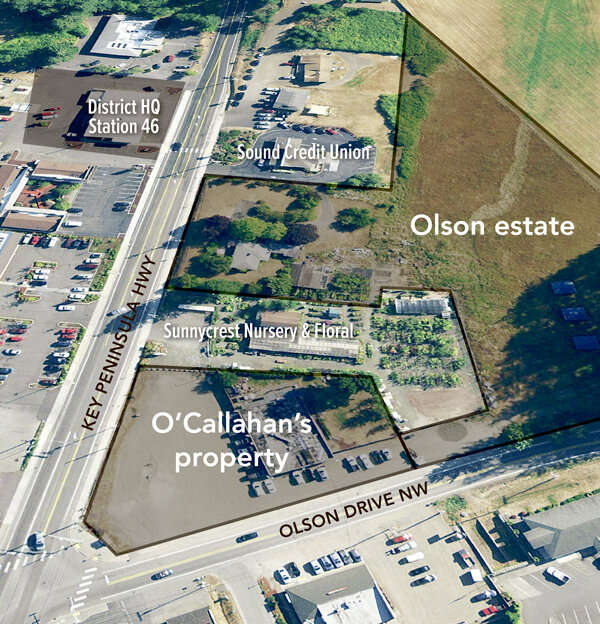
Key Peninsula Fire District 16 received a new $1,050,000 purchase and sale agreement July 7 for the Calahan property it has owned for over four years, signed by John Park, owner of Taechang LLC of Gig Harbor.
The agreement is nearly identical to one entered into by KPFD and Park that fell apart earlier this year when Park failed to deliver required escrow funds and ceased communication with the district’s real estate broker.
The KP fire commissioners could vote on whether to accept Park’s offer as soon as their next regularly scheduled meeting, July 28. KP News learned details of the deal in advance from multiple sources inside and outside of KPFD, who agreed to speak anonymously since they were not authorized to do so.
According to the agreement, Park must deposit his $50,000 earnest money within three days of mutual acceptance; $10,000 becomes nonrefundable almost immediately but is applied to the purchase price. If Park asks for a 30-day extension (up to four allowed), another $10,000 becomes nonrefundable.
The deal is contingent upon Park receiving a Pierce County permit to “remodel and/or construct a convenience store/gas station,” obtaining a liquor license to sell beer and wine, and the district’s successful repair of the septic system.
That system has been a sticking point for the commissioners. Sources inside and outside KPFD indicated the system should be replaced, and that an initial estimate of $24,000 for repairs may be inadequate. Pierce County has made repair or replacement a condition of the deal, but at least one source thought that was negotiable.
The department has already spent an estimated $60,000 on repairs to the former O'Callahan's building, and has had little luck renting it or the Olson residence to tenants.
“As it stands right now, we’ve forwarded that offer to all the commissioners for them to further evaluate and digest,” said Commissioner Stan Moffett, one of two members of the facility planning committee. “We will make a decision at the next meeting on how we will respond to that offer.”
One opponent to the Park sale is the Key Commons Working Group of self-described “community members and taxpayers” who formed late last year to work with KPFD on developing alternatives. It has since become a registered Washington state nonprofit led by Home resident Lysanna Anderson, and is pursuing 501(c)(3) status.
“We are committed to this property being utilized in service to the community,” she said. “If our community doesn’t want a gas station there, we shouldn’t have to tolerate one. The fire commissioners need to hear from us in person.”
KPFD bought the Calahan property (also called O’Callahan’s, after the former restaurant on the site) in November 2021, for $950,000. It purchased two adjacent Olson estate parcels in December for $1.2 million as part of its plan to build a new fire department headquarters, training center, and clinic. The purchases became controversial after public perception that the district overpaid for properties with money that could have been spent better elsewhere.
The department financed the two purchases of the three parcels by issuing a private bond for $2.125 million at 1.82% interest, according to the loan documents.
Biannual debt service was interest only, starting at $13,106.53 on Dec. 1, 2021, until Dec. 1, 2024, when principal and interest payments started at $129,337.50 and will become payable every six months until 2040.
The commissioners anticipated paying at least part of the debt through rental income from the residence and the restaurant, but after difficulty collecting rent from tenants, both have remained vacant.
The financing mechanism for the properties is a limited tax general obligation bond, a type of municipal bond issued by local governments to fund public projects “constrained by statutory limits on the tax rates or amounts that can be levied to repay the debt,” according to a definition by the National Association of Bond Lawyers.
It is a so-called “non-voted debt,” since the “bonds are usually issued directly by a city council or local governing body without requiring a public referendum. … The issuer promises to use its general revenue and taxing power to make interest and principal payments (in this case through a 1.8% interest loan). However, this ability to raise taxes is strictly restricted by state laws. If a shortfall occurs, the municipality cannot legally raise taxes beyond a predetermined cap to cover the debt.”
Lisa Bryan and Eddie Macsalka contributed to this report.


UNDERWRITTEN BY THE FUND FOR NONPROFIT NEWS (NEWSMATCH) AT THE MIAMI FOUNDATION, THE ANGEL GUILD, ADVERTISERS, DONORS AND PEOPLE WHO SUPPORT INDEPENDENT, NONPROFIT LOCAL NEWS