I live in Lakebay, which means I have spent more hours than I’d care to admit figuring out how to get a reliable internet connection to a house at the end of a long driveway. If you’re reading this, odds are good you have too.
Out here, the options have always been a short and frustrating list. CenturyLink was happy to sell you DSL, but the technology underneath it hasn’t meaningfully improved in decades. If social media is any guide, customer service has suffered since the sale of its Washington network to AT&T in February, excluding its copper wire connections.
Astound (formerly Wave) cable is real broadband if you can get it, but the company runs its lines about as far as the math tells it to, and for a lot of us the math often says no, but not always. The Herron Island project that was supposed to help got canceled back in January due to a permitting snafu. It would have run fiber to the home free to island subscribers since they had county money for the project.
And then there’s Starlink, which works pretty well, provided you’re willing to clear some trees, pay for the hardware up front, and make peace with who owns it — especially since Starlink got the contract to provide broadband internet to the KP, including free hardware and a low-cost subscription through the Broadband Equity, Access, and Deployment project. (See “Broadband Access Expands on the Key Peninsula,” April 2026.)
Regardless of our feelings about the CEOs of different providers, a lot of us don’t want a dish on the roof of any kind, and I’m definitely not going to talk anyone out of a decision that’s really about values rather than bandwidth. But when the people who’d profit from selling you the dish call it a backup, I tend to believe them.
Which leaves the option I think is the best bet for most of us, and the one I get asked about most: fixed wireless internet, or 5G home internet. In my experience, T-Mobile’s version is the strongest on the peninsula, as long as you have a reasonably clear view to the east toward the tower. It runs somewhere between $50 and $80 a month with no contract, the equipment arrives in a tidy box, and you set it up yourself in about the time it takes to make coffee. The speeds aren’t close to what DSL gives you — they’re far better.
Verizon has a competing product that works for some of my neighbors, though its coverage here is thinner and harder to predict. I have friends on the east side of the KP who use T-Mobile, and extend it to their guests at their VRBO without complaint. “We’ve been very happy with T-Mobile over the last couple of years, and run cameras, daily internet, and VRBO guest internet with no issues.”
Here’s the rub. Both Verizon and T-Mobile will happily show you a coverage map and let you type in your address to see whether you qualify, though in the past they’ve also instituted data caps. In my experience, good speeds on T-Mobile require a clear view to the east, and tend to work best on the shoreline. If you can see Mount Rainier, it will probably work great. T-Mobile’s checker lives at t-mobile.com/home-internet/eligibility. I’d treat whatever it tells you as a starting point and nothing more.
For most of us, T-Mobile or Verizon are going to be our best untethered options, but let’s talk about Astound and CenturyLink. For Astound (formerly Wave), if you have it available, you probably already know it. But if you don’t, there is another more expensive, complicated, and time-consuming route, and that’s to ask them to bring it down your driveway. You don’t really know the feasibility or price unless you ask, but getting Astound to your house will be by far the fastest and most reliable option, with speeds getting close to 1Gbps or 1000 Mbps, with an average of around 600-800 Mbps.
Compare that to CenturyLink at 10 Mbps and, well, you’re light years ahead.
For an Astound project, they will look at how many neighbors might subscribe and then split the onboarding cost between multiple parties or negotiate. The subscription cost for Astound is also a bit higher than T-Mobile, running around $120 a month, plus the engineering fees, but this is actually a case of you get what you pay for. If you’re running a business, or have multiple teenagers, it might be worth it.
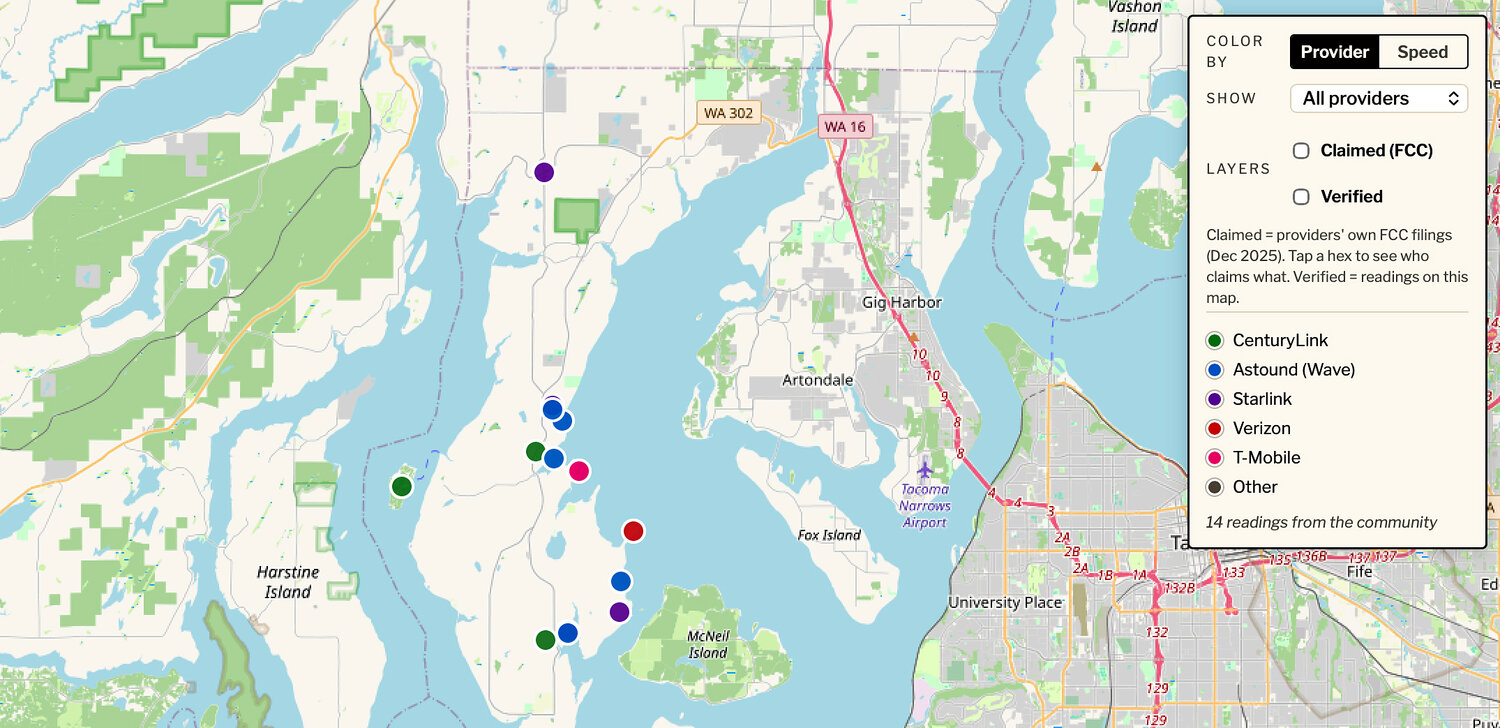
We look forward to getting our open source community map (https://keypen-internet-map.netlify.app/) up and running, and the more people share their speeds, the better data we’ll have for all of us. It’s worth noting that the map is intentionally optimized for low internet speeds, so it should work with whatever internet you currently have.
Overall, life on the beautiful and rural peninsula has its upsides, and internet speed and availability are not among them. But one thing we do well is coming together as a community, sharing information and experiences, and helping each other.
Thad Dickson is CEO of Xpio Health, a Gig Harbor company focused on security and compliance for healthcare organizations. He lives in Lakebay.


UNDERWRITTEN BY THE FUND FOR NONPROFIT NEWS (NEWSMATCH) AT THE MIAMI FOUNDATION, THE ANGEL GUILD, ADVERTISERS, DONORS AND PEOPLE WHO SUPPORT INDEPENDENT, NONPROFIT LOCAL NEWS